
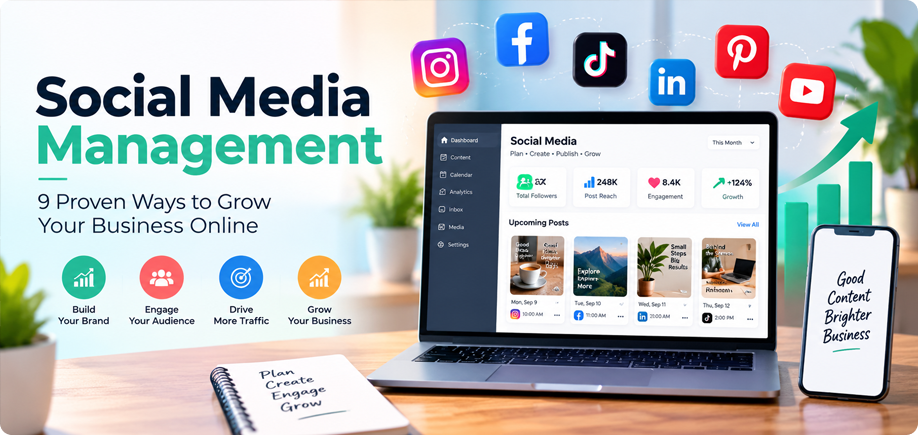
Social Media Management: 9 Proven Ways to Grow Your Business Online
Social Media Management is no longer simply about publishing an occasional Facebook or Instagram post. For modern businesses, social media has become an important part of brand communication, customer service, marketing, lead generation, and long-term relationship building.
Your customers may discover your business through Instagram, check your Facebook page before contacting you, watch your videos, read comments from other customers, or compare your online presence with competitors. If your social profiles look inactive, inconsistent, confusing, or unprofessional, potential customers may form the wrong impression before they ever visit your website.
Effective Social Media Management creates a clear system for planning, designing, publishing, monitoring, and improving your social media presence. Instead of posting without direction, your business communicates consistently with the right audience and works toward specific marketing goals.
Table of Contents
- What Is Social Media Management?
- Why Social Media Management Is Important
- 9 Benefits of Professional Social Media Management
- Managing Different Social Media Platforms
- Building an Effective Content Strategy
- Common Social Media Management Mistakes
- The ONNAX Social Media Management Process
- Who Needs Social Media Management?
- Building a Stronger Social Media Presence
What Is Social Media Management?
Social Media Management is the ongoing process of planning, creating, publishing, monitoring, and improving content across social media platforms such as Facebook, Instagram, LinkedIn, Pinterest, TikTok, and others.
It combines several activities rather than focusing only on posting. A complete management process may include content planning, graphic design, caption writing, scheduling, audience engagement, campaign coordination, hashtag research, performance monitoring, and monthly reporting.
The purpose is to give your business a consistent and professional online presence while ensuring that social media activities support larger business goals.
For example, one business may use social media mainly to generate leads, while another may focus on product sales, brand awareness, community engagement, or customer education. A good strategy is designed around those specific objectives instead of following the same approach for every company.
Why Social Media Management Is Important for Businesses
Customers increasingly expect businesses to have an active and trustworthy digital presence. When someone discovers your company, they may visit your social profiles before making a purchasing decision.
A professionally managed profile shows that your business is active, organized, responsive, and serious about its brand. Consistent colors, graphics, tone of voice, and messaging also make your company easier to recognize.
Without proper management, businesses often post irregularly, use inconsistent graphics, forget important messages, repeat the same content, or publish without knowing what their audience actually finds useful.
Social Media Management replaces this uncertainty with a structured approach. Your business knows what will be published, why it is being published, which audience it is intended for, and what result it should help achieve.
9 Proven Benefits of Professional Social Media Management
1. Creates a Consistent Brand Presence
Consistency is one of the most important parts of branding. Your logo, colors, typography, imagery, messaging, and overall visual style should feel connected across your social media channels.
Professional Social Media Management helps maintain that consistency. When people repeatedly see a recognizable visual identity, they become more familiar with your business and are more likely to remember it later.
2. Saves Valuable Business Time
Creating graphics, writing captions, choosing hashtags, scheduling posts, replying to comments, and checking performance can consume many hours each week.
For a business owner, that time may be better spent serving customers, developing products, managing employees, or handling sales. Outsourcing or organizing social media management reduces the amount of daily manual work required.
3. Improves Content Quality
Posting frequently does not automatically produce results. Quality matters.
A strong social media post should have a clear purpose, attractive design, useful or interesting information, readable text, an appropriate caption, and a relevant call to action.
Professional management allows content to be prepared in advance instead of being created quickly at the last moment.
4. Helps You Reach the Right Audience
Different audiences use social media differently. A professional service company targeting corporate clients may benefit from LinkedIn, while a fashion or food brand may depend heavily on Instagram and visual content.
Understanding where your ideal customers spend time allows your business to focus its effort on the platforms that matter instead of trying to maintain every social network without a clear reason.
5. Improves Customer Engagement
Social media is a two-way communication channel. Customers may ask questions, leave comments, send direct messages, share posts, or mention your business.
Responding professionally helps strengthen relationships and shows potential customers that your business values communication.
Engagement also helps businesses understand what customers are interested in, which questions appear frequently, and what type of content generates meaningful responses.
6. Supports Website Traffic and Lead Generation
Your social profiles can guide interested visitors toward important areas of your website, including service pages, products, landing pages, blog articles, booking forms, and contact pages.
For example, an educational post might introduce a common customer problem and then direct readers to a detailed article or service page where they can learn more.
This creates a stronger connection between your social media activity and your website rather than treating them as completely separate marketing channels.
7. Strengthens Brand Trust
People often research a business before contacting or purchasing from it. An abandoned profile with outdated information can create uncertainty.
Regular, useful, and visually professional content reassures potential customers that your business is active.
Customer testimonials, completed projects, educational content, behind-the-scenes posts, company updates, and useful advice can all contribute to building credibility.
8. Makes Marketing More Organized
A content calendar allows you to plan promotions, educational posts, product launches, seasonal campaigns, company announcements, and other important content before the publishing date arrives.
This makes marketing more organized and reduces the risk of forgetting important events or repeatedly publishing similar content.
9. Provides Data for Better Decisions
Social platforms provide valuable information about reach, engagement, clicks, followers, video views, audience behavior, and other performance indicators. For example, Meta Business Suite provides tools for managing content and reviewing performance across Facebook and Instagram. For example, Meta Business Suite provides tools for managing content and reviewing performance across Facebook and Instagram.
These numbers should not be viewed simply as scores. They can help identify patterns.
If educational posts consistently generate more engagement than promotional posts, for example, your future strategy can include more educational content. If certain topics generate website clicks or inquiries, those topics may deserve greater attention.
Managing Different Social Media Platforms
One common Social Media Management mistake is publishing exactly the same content in exactly the same format everywhere.
While maintaining brand consistency is important, different platforms have different audiences, content formats, and user behavior.
Instagram is highly visual and works well for branded graphics, photographs, Reels, carousels, Stories, products, portfolios, and educational content.
Strong visual consistency can help make the overall profile feel professional and recognizable.
Facebook can support business announcements, offers, community interaction, customer communication, videos, links, events, and longer informational posts.
It can also be valuable for businesses that already have an established local or community-based audience.
LinkedIn is particularly useful for professional services, B2B companies, agencies, consultants, and businesses targeting decision-makers.
Content may focus more heavily on expertise, industry insights, case studies, company developments, professional achievements, and educational information.
Pinterest can be particularly useful for visual industries such as design, fashion, home improvement, weddings, crafts, food, printable products, and e-commerce.
Well-designed Pins can continue generating discovery and website visits long after they are initially published.
Building an Effective Social Media Content Strategy
Successful Social Media Management begins with strategy rather than random posting.
The first step is understanding your business objectives. Do you want more website visitors, inquiries, product sales, bookings, followers, brand awareness, or customer engagement?
The next step is understanding your audience. Good content addresses topics that matter to potential customers instead of talking only about the company itself.
A balanced content strategy may include:
- Educational content: Tips, guides, explanations, and useful industry knowledge.
- Promotional content: Products, services, special offers, packages, and new launches.
- Brand content: Company values, behind-the-scenes information, team updates, and business milestones.
- Trust-building content: Reviews, testimonials, completed projects, case studies, and results.
- Engagement content: Questions, polls, discussions, quizzes, and interactive posts.
- Video content: Reels, tutorials, demonstrations, short educational clips, and product videos.
The exact mixture depends on your industry and audience. The goal is to avoid making every post an advertisement while still giving followers clear opportunities to become customers.
Common Social Media Management Mistakes
Many businesses spend significant time on social media without achieving meaningful results because their activity lacks consistency or direction.
Posting Without a Strategy
Publishing content simply because the business feels it “should post something today” often results in disconnected messages. Each post should support a broader content plan.
Inconsistent Branding
Changing fonts, colors, graphic styles, and tone constantly can weaken brand recognition. Establishing a visual system helps your content look connected.
Posting Only Promotional Content
If every post says “buy now,” “contact us,” or “get our service,” followers have little reason to remain interested. Valuable educational and engaging content should support promotional posts.
Ignoring Comments and Messages
Social media is not only a publishing platform. Businesses should monitor interactions and respond appropriately to genuine customer questions and feedback.
Using Poor-Quality Graphics
Blurry images, crowded layouts, tiny text, incorrect dimensions, or inconsistent designs can make an otherwise professional business appear less credible.
Focusing Only on Follower Numbers
Having a large follower count does not necessarily mean social media is generating business results. Relevant engagement, website visits, inquiries, leads, and conversions may be more valuable indicators.
Ignoring Performance Data
Continuing to publish without reviewing performance means useful information is being wasted. Regular analysis can help improve future content.
The ONNAX Social Media Management Process
At ONNAX, Social Media Management is approached as an organized business process rather than simply filling a posting calendar.
Our approach can be adapted according to your brand, industry, target audience, available platforms, and marketing objectives.
- Business and Brand Review: We understand your services, products, audience, existing branding, competitors, and communication goals.
- Platform Planning: We identify which social channels deserve attention based on your business and audience.
- Content Strategy: We develop relevant content themes including educational, promotional, trust-building, and engagement-focused posts.
- Visual Direction: Graphics are created using consistent colors, typography, layout principles, and brand elements.
- Content Creation: Posts, captions, calls-to-action, and supporting content are prepared according to the approved strategy.
- Scheduling and Publishing: Content is organized and published according to the planned schedule.
- Engagement and Monitoring: Social activity can be monitored so important interactions and customer responses are not overlooked.
- Performance Review: Results can be reviewed to identify what works and improve future content decisions.
The objective is to create a consistent system that makes your brand easier to recognize, reduces unnecessary workload, and helps social media contribute to your overall digital presence.
Who Needs Professional Social Media Management?
Social Media Management can benefit almost any organization that depends on attracting, educating, or communicating with customers online.
It is particularly useful for:
- Small businesses that do not have an internal marketing team
- Startups building their first professional brand presence
- Online stores promoting products and offers
- Restaurants, cafés, and hospitality businesses
- Real estate and property businesses
- Professional service providers
- Healthcare and wellness businesses
- Educational organizations
- Personal brands and consultants
- Agencies and B2B companies
Even businesses that do not sell directly through social media can benefit from maintaining a professional profile. Potential clients may still use social platforms to verify your credibility before contacting you.
Build a Stronger Social Media Presence
Social media can be a valuable business tool, but results rarely come from random posting. Sustainable progress requires consistent branding, useful content, organized publishing, audience awareness, and ongoing improvement.
Professional Social Media Management helps bring these elements together into one clear system. It can save business owners time, improve brand presentation, strengthen customer relationships, and create more opportunities for people to discover your products or services.
The most effective strategy is not necessarily the one that produces the highest number of posts. It is the one that communicates consistently with the right audience and supports your real business objectives.
ONNAX can help your business build a professional, consistent, and results-focused social media presence. From content planning and branded graphics to organized publishing and ongoing management, our goal is to make your social channels work more effectively for your business.
Contact ONNAX to discuss your Social Media Management requirements and create a strategy suited to your brand.